
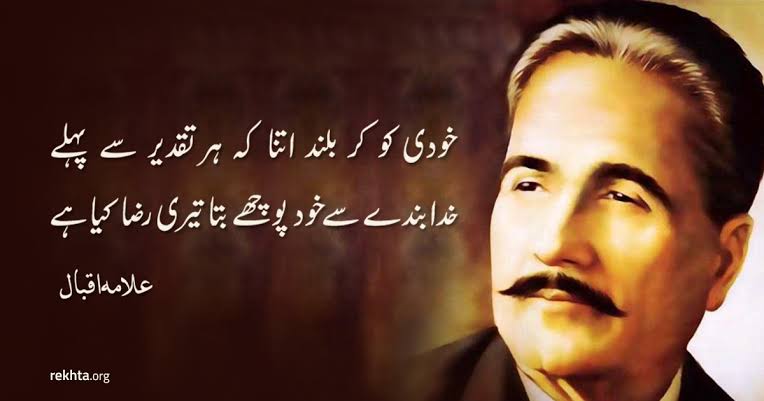
According to Allama Muhammad Iqbal, Ego (Khudi) is the ability of an individual which enables that individual to play an active, dynamic and free role in shaping and reshaping personal as well collective behavior.
Iqbal’s philosophy essentially revolves around the issue of the progression of human being, or the rise of the “self” or “ego” — the Iqbalian khudi…. in the direction of attaining exalted heights — the heights at which Almighty Allah (SWT) Himself begins to take the wishes, hopes, and aspirations of the human being into account before formulating His decree. Iqbal argues that khudi is the root of all existence, an entity which may appear to be perishable but which can attain immortality. The human ego or “I” has the potential of achieving permanence as an element in the constitution of the universe provided that it adopts a certain mode of life. The ego can evolve, progress, and succeed as well as degenerate, atrophy, and fail. The Qur’an puts these two possibilities as follows: “The one who causes this (self) to grow in purity has indeed attained success; and the one who is negligent of this (self) has indeed utterly failed” (AlShams 91:9, 10). The human ego has the ability to grow by absorbing the elements of the universe, of which it appears to be an insignificant part, as well as the ability to incorporate the attributes of Allah (SWT). Muslim Sufis have advised: “Create in yourself the attributes of Allah.” If the human ego is able to do this, it would become worthy of being the vicegerent of God on earth. Iqbal argues that the human ego has a central place in the universe, while it is, at the same time, intimately linked with the Ultimate Ego, or God Himself. Iqbal notes throughout the entire gamut of being runs the gradually rising note of egohood until it reaches perfection in man. That is why the Qur’an declares the Ultimate Ego to be nearer to man than his own neckvein. In order to reach these noble heights of perfection, the ego has to pass through three stages which Iqbal describes in Asrar-e-Khudi. These three stages can be seen as the different spiritual phases through which the ego has to pass in its journey of spiritual ascension: Ita‘at, or obedience to the Divine Law; Dabt-e-Nafs, or self-control, which is the highest form of self-consciousness or egohood; Niyabat-e-Ilahi, or the vicegerency of God.
Iqbal distinguishes between two aspects of the Self, the efficient and the appreciative. The efficient self is that which is concerned with, and is itself partially formed by, the physical world. It apprehends the succession of impressions and discloses itself as a series of specific, and consequently numerable states. The appreciative self is the deeper self, of which one becomes aware only in moments of profound meditation when the efficient self is in abeyance. The unity of the appreciative self is that in it, each experience permeates the whole. The multiplicity of its elements is unlike that of the efficient self. There is change and movement, but this change and movement are indivisible; their elements interpenetrate and are wholly non-serial in character. Corresponding to the two aspects of the Self are the two levels of time, serial time and pure duration. Serial time is spatial or clock time, whereas pure duration is a ceaseless continuous flow in which all things live and move and have their being. As human beings perfect their ego-hood, they cast off the girdle of serial time and gain a measure of eternity. Iqbal believes ardently that human beings are the makers of their own destiny and that the key to destiny lies in one’s character. He constantly refers to the Qur’anic verse, ‘Verily God will not change the condition of a people till they change what is in themselves’ (Surah 13: 12). Humanity’s mission on earth is not only to win greater freedom but also to gain immortality, which according to Iqbal: ‘is not ours by right; it is to be achieved by personal effort. Man is only a candidate for it’ (Iqbal 1930: 119).
For Iqbal freedom is the Summum Bonum of human existence. A deep analysis of his conception of freedom, as elaborated in his poetry and philosophical writings, may justifiably lead us to the conclusion that in his thought freedom is the source of all values. He maintains that the life of ego is possible in freedom only. In one word, “life is an endeavor for freedom.” In his ‘Reconstruction of Religious Thought in Islam’ Iqbal holds that “there are only ego-sustaining and ego-dissolving 2 acts.” And freedom, in its strict sense, sustains the ego. No Muslim Philosopher, before Iqbal, had given the highest position to freedom in the hierarchy of values. For him freedom is not only a value or mode of human existence, it is, as stated earlier, the very life of ego. In the philosophy of Iqbal, man’s Khudi, with its basic and significant qualities freedom and creativity is the force that creates itself as well as the world. Freedom and creativity are the outstanding qualities which human ego unfolds to shape and mould its particular historic situation according to its aspirations. Creativity and freedom are interconnected, since the act of creation requires freedom. Freedom is the source of all values and in the real sense of the word, it is the life of ego. “Regarding freedom and creativity Iqbal has alluded to various Qur’anic verses in his Urdu and Persian poetry. In the Reconstruction of Religious Thought in Islam, he specifically dealt with this issue. In his fourth Lecture, The Human Ego—His Freedom and Immortality”, Iqbal presents significant themes from the Qur’an: Man being a vicegerent of God, a chosen entity and “the trustee of a free personality which he accepted at his peril. “Iqbal argues that man’s freedom and creativity, at the early stage of life, must be under the control and guidance of Law that may teach him to abide by certain moral principles: The greatest obstacle in the way of life is matter, Nature; yet Nature is not evil, since it enables the inner powers of life to unfold themselves ‘The Ego attains to freedom by the removal of al l abstractions in its way. It is partly free, partly determined, and reaches full freedom by approaching the Individual who is most free —-God.
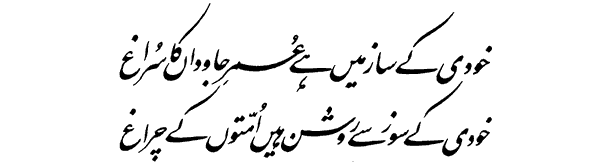
According to Iqbal, God has created everything that is in Heavens and earth for His Vicegerent man. Human being is free at his will to make use of all that has been bestowed on him by his Supreme Creator (Allah). But this worldly material life is not his ultimate destiny. It only paves the way that leads towards the higher life. Man’s aim, according to Iqbal, must be nearness to God, who alone is the source of his freedom. By exercising his freedom and creativity he can conquer the material world and reach fuller freedom through approaching God, who is Absolute Freedom, In brief, man’s highest achievement or distinction, according to Iqbal, does not li e in seeking self-negation or detachment from the material world and in the annihilation of his egohood in the Ultimate Reality (fana fi Allah). Iqbal says about the immortality of ego in his poetry that;
 Amjad's Blogs